Senior policymakers and leading academics from Asia, the United States and Europe convened in Beijing to develop practical policy responses to today’s evolving global challenges. The conference focused on strengthening international cooperation amid geopolitical uncertainty, technological transformation and economic fragmentation.
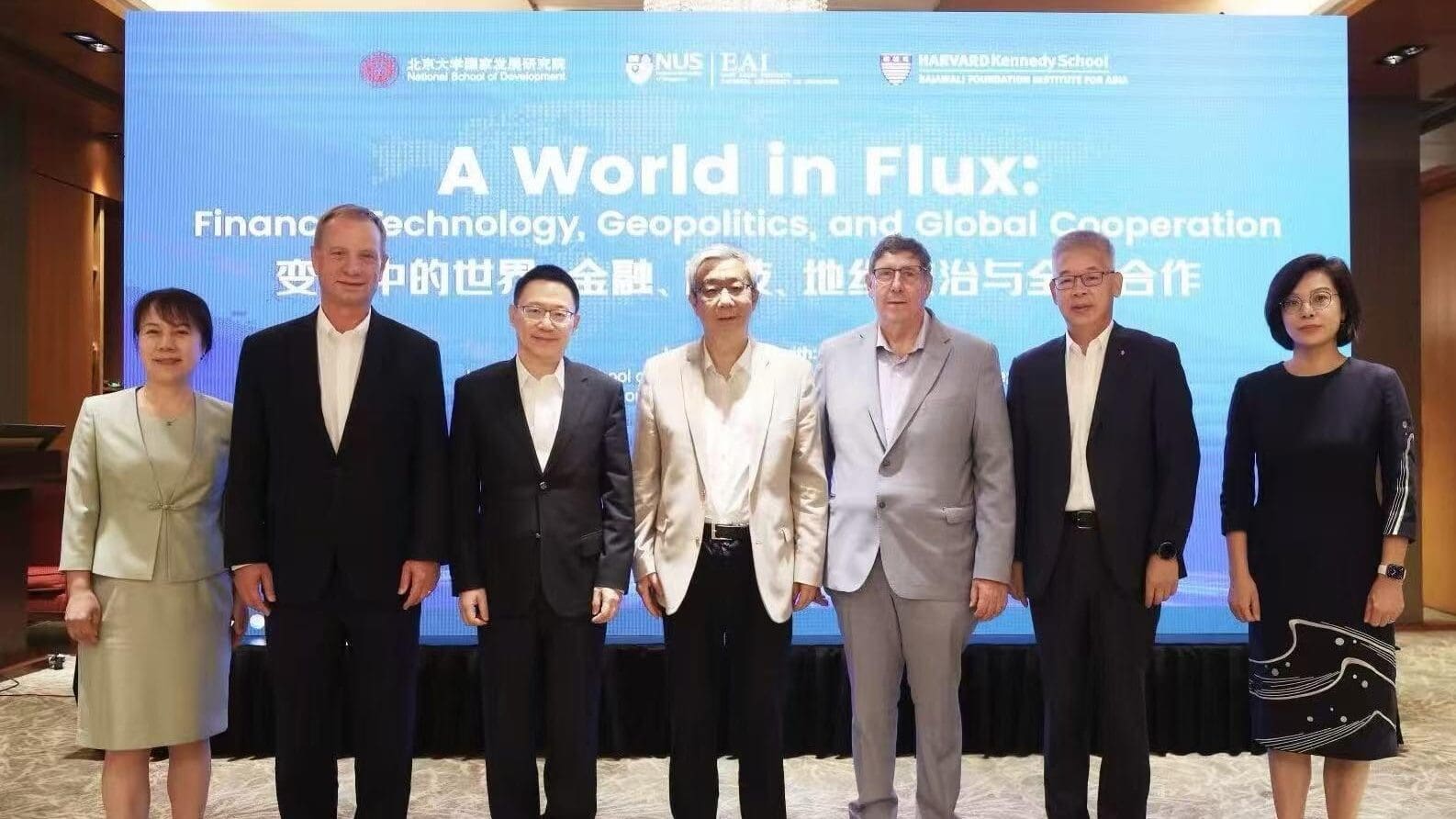
Leading policymakers, scholars and international experts from Asia, the United States and Europe gathered in Beijing on 21–22 July 2026 for the conference A World in Flux: Finance, Technology, Geopolitics, and Global Cooperation. Jointly organised by the East Asian Institute (EAI) at the National University of Singapore, the National School of Development (NSD) at Peking University, and the Rajawali Foundation Institute for Asia at Harvard Kennedy School, the event sought to advance practical, evidence-based policy solutions to the complex challenges reshaping the global landscape.
Held against the backdrop of rising geopolitical tensions, rapid technological advances and increasing economic fragmentation, the two-day conference centred on actionable responses rather than theoretical discussions. Participants examined issues including the future of the international economic order, artificial intelligence and technological innovation, trade and supply-chain resilience, energy security, critical resources, and the role of international cooperation in promoting global stability and sustainable growth.
The conference officially opened with keynote remarks by Mr. Liao Min, Vice Minister of Finance of the People’s Republic of China, who highlighted China’s commitment to high-quality development while underscoring the importance of continued dialogue and international cooperation during a period of global uncertainty. The Beijing meeting marks the third instalment of the conference series, following previous editions held in Singapore in January 2025 and at Harvard Kennedy School in Boston in December 2025, reinforcing the partnership as a trusted platform for constructive policy exchanges.
Speaking on the significance of the initiative, Professor Alfred Schipke, Director of the East Asian Institute at the National University of Singapore, stressed that sustained dialogue is essential to developing practical solutions that enhance resilience and cooperation. Professor Huang Yiping, Dean of the National School of Development at Peking University, emphasised that many of today’s economic and technological issues transcend national borders and require rigorous, research-driven collaboration. Professor Anthony Saich, Director of the Rajawali Foundation Institute for Asia at Harvard Kennedy School, added that academic institutions provide trusted spaces where evidence-based discussions can help inform policymaking on complex global issues.
Beyond the conference series, the three institutions continue to deepen their collaboration through joint research projects, policy publications, workshops and academic exchanges. Their ongoing partnership aims to foster evidence-based policymaking while strengthening international dialogue and cooperation in addressing shared global challenges.
Source: NUS East Asian Institute