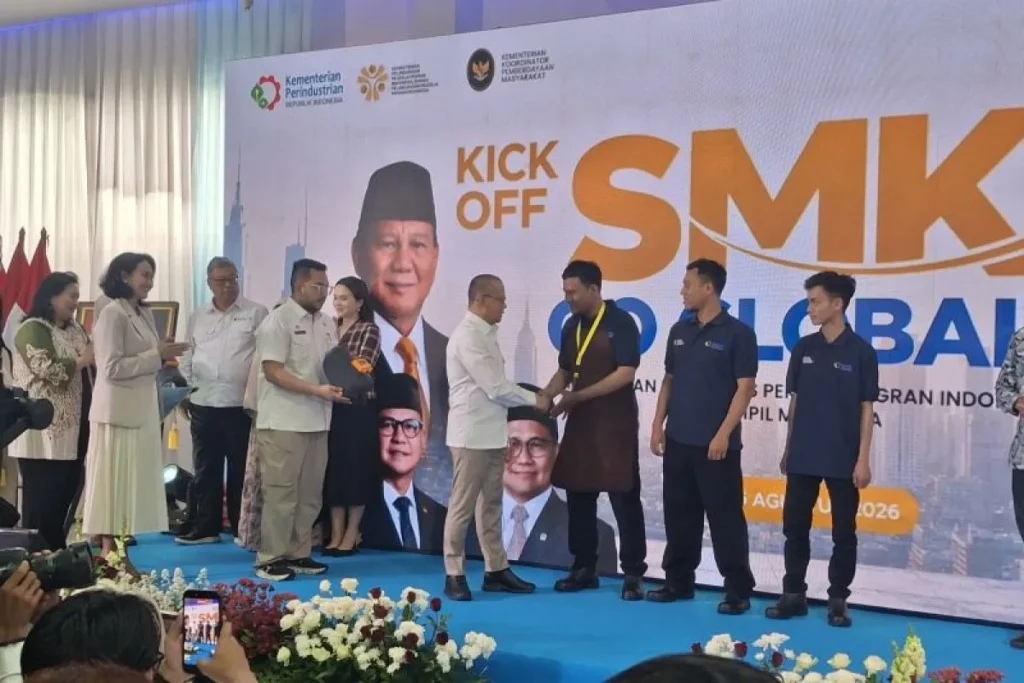
Indonesia expands skills training and certification to prepare workers for global employment.
Indonesia is targeting 500,000 skilled migrant workers through the SMK Go Global programme, which aims to strengthen technical skills, language abilities and internationally recognised certifications for overseas employment.
Indonesia’s Minister of Migrant Worker Protection, Mukhtarudin, said the programme is intended to ensure prospective migrant workers have the competencies needed to compete in international labour markets and secure decent employment overseas.
“SMK Go Global is not merely a training programme. It is an effort by the government to prepare Indonesia’s young generation with competencies and certifications recognised globally,” Minister Mukhtarudin said at the programme’s launch at the Industrial Training Centre (BDI) in East Jakarta on Wednesday (26 August).
The programme is designed to reach a broad pool of prospective migrant workers. While it focuses on vocational high school (SMK) graduates, general high school and university graduates, including bachelor’s and master’s degree holders, can also participate.
The initiative follows President Prabowo Subianto’s direction to prepare 500,000 workers, comprising 300,000 prospective migrant workers from vocational schools and 200,000 from general education backgrounds.
To meet this target, participants will undergo integrated upskilling covering technical competencies, competency certification and language training. The training will be tailored to specific industries and destination countries so participants can prepare for jobs aligned with overseas market requirements.
Target sectors include caregiving, welding, hospitality, nursing, truck driving, manufacturing, transportation, agriculture, construction and maritime industries.
Potential destinations include Japan, South Korea, Germany, Australia, Malaysia, Singapore, Türkiye, Taiwan and other European countries. Placements will be carried out gradually, taking into account labour market demand and global geopolitical conditions.
The programme uses sector, occupation, destination-country, qualification and skills mapping to ensure training reflects actual requirements in overseas labour markets.
Minister Mukhtarudin stressed that this approach is increasingly important as global employment standards continue to rise.
“Global labour markets have increasingly high standards. Therefore, curricula and training must follow industry needs. We cannot prepare workers based merely on assumptions, but must rely on data on actual labour market demand,” he said.
By aligning training with real overseas demand, the Indonesian government aims to equip its workers with stronger skills and recognised qualifications, giving more Indonesians the opportunity to compete for decent employment in the global labour market.
Source: ANTARA News