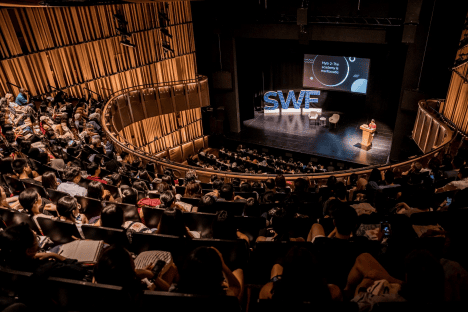
SWF 2025 at a Glance:
● Over 440 local and international presenters
● More than 220 programmes across 20 venues
● First-ever live translation for Chinese, Malay, Tamil (CMT) programmes
● Increased community outreach engagement across public, everyday spaces
● Strong SG Culture Pass uptake and sold-out Festival passes
● Over 40 sold-out ticketed sessions and numerous Festival Pass programmes with full capacity
● Increase in over 30% of Festivalgoers through expanded access
SINGAPORE, 18 November 2025 — Organised by Arts House Group (AHG) and commissioned by the National Arts Council, the 28th edition of the Singapore Writers Festival (SWF) united over 440 local and international voices across more than 220 programmes to 16 November 2025. Under the direction of Festival Director Yong Shu Hoong, SWF 2025 concluded on an inspiring note, inviting audiences to look ahead with imagination and optimism as Singapore marks 60 years of independence.
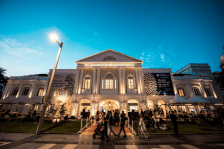

Image left: The Arts House at the Old Parliament came alive at night with the written and spoken word. Image right: Audiences at Singapore, Truly: A Spoken Word Showcase enjoyed a warm, welcoming experience, seated comfortably on the floor against a colourful backdrop. Photos credit: Arts House Group
Through stories that explore uncertainty, question identity and imagine new futures, the Festival celebrated the power of words to illuminate what lies ahead. Spanning 20 venues across the city, SWF 2025 welcomed writers, thinkers and creators from fields as varied as Sci-Fi, speculative fiction, technology, food and the humanities. Alongside the core programmes, community initiatives brought the Festival’s spirit directly into public, everyday spaces and the neighbourhoods, encouraging shared encounters and sparking connections among Singaporeans of all ages.
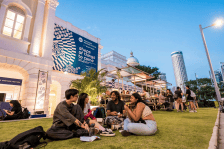

Image left: Festivalgoers soaking in the cool evening breeze and vibrant festival vibes on the lawn at The Arts House at the Old Parliament. Image right: Through urban sketching, creative writing and translation in Sketching Tomorrow’s Hawker Stories, participants shared laughter as they explored how words and images intertwine to capture the rich textures of everyday life. Photos credit: Arts House Group
Yong Shu Hoong said, “Over the 10 days of the Festival, it has been inspiring to see audiences engage deeply with ideas that push us to reimagine the world while lending strong support of both international and Singapore presenters. What struck me most was the courage and curiosity that audiences brought to every conversation. Their willingness to explore unfamiliar ideas reminds me why the literary arts continue to matter. As we look towards Singapore’s next chapter, I am encouraged by how writers and readers alike are embracing new perspectives while staying rooted in the stories that ground us.”
International Voices and Sold-out Highlights
One of the biggest draws this year was the line-up of more than 40 acclaimed regional and international authors presented alongside local speakers. This included #1 New York Times bestselling novelist R. F. Kuang, Hugo Award-winning writers Ken Liu and Hao Jingfang, and acclaimed poet Victoria Chang, as well as popular Singaporean writers and artists like Pooja Nansi, Liang Wern Fook, and Shabir Sulthan who filled venues to the brim.
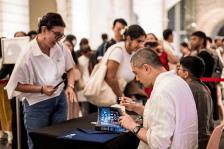

Key headliners such as Ken Liu and R.F. Kuang drew packed venues for their talks and book signings. Photos credit: Arts House Group
In conversation with Singaporean novelist Balli Kaur Jaswal, Kuang reflected on themes of academic survival and institutional crisis, and how these ideas intertwine and unfold in her latest novel, Katabasis. This programme saw exceptional demand, selling out within a day of the Festival’s launch.
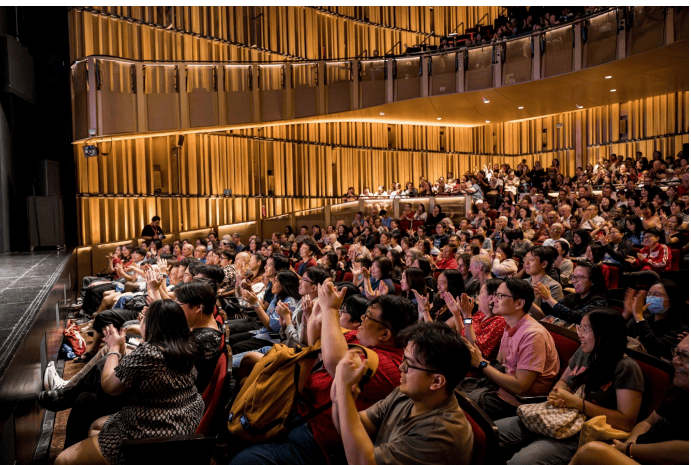
The Festival also saw over 40 sold-out sessions for ticketed programmes such as the A Feast of Words & Flavours series, The Shadow of Things to Come, and When Worlds Fall Apart: Writing Dystopias with Neal Shusterman, Live Drawing Battle with Christopher Boyd, Chloe Chang and Ong Chao Hong, Shaping Psychopaths and Sociopaths with Ellie Marney, amongst many others.
Singaporean freelance author and illustrator of picture books Quek Hong Shin shared, “I had the pleasure of meeting Christopher Boyd, a comic artist and illustrator from France. It was a fortuitous connection between two artists of vastly different backgrounds, and one that is very memorable for me at this edition of SWF.”
Festival Passes were sold out within the first weekend, and many programmes quickly reached full capacity, including Kim Yideum: Feminism and the Female Voice in Korean Literature and Poetry is not a Luxury which saw all-women panel comprising poet Pooja Nansi, Arts House Literary Fellow Marylyn Tan together with Kim Yideum tackle questions surrounding how gender concerns and politics can play a role in shaping and reimagining poetry, as well as promoting causes still in dire need in today’s fragmented world.
Increased Accessibility through Strengthened CMT Programming and Diversified Voices
SWF continued to strengthen its role as one of the world’s few multilingual literary festivals. Working closely with guest curators, the Festival presented a vibrant mix of Chinese, Malay and Tamil programmes featuring local and international voices.
Kavipperukku – Aspire the Infinite, a Tamil spoken-word poetry performance celebrating the richness of the Tamil language through original works and live music, drew a strong audience at Victoria Theatre and offered a memorable, immersive experience. Guest curator for Tamil programmes Chitra Ramesh reflected on the SWF experience she described as both enriching and deeply rewarding. “Curating the Tamil-language programmes allowed me to showcase the diversity and vibrancy of Tamil literature and its evolving voices in Singapore and beyond. It was a privilege to bring together writers, poets, and thinkers who not only celebrate the beauty of the language but also engage with contemporary issues and cross-cultural dialogues.”

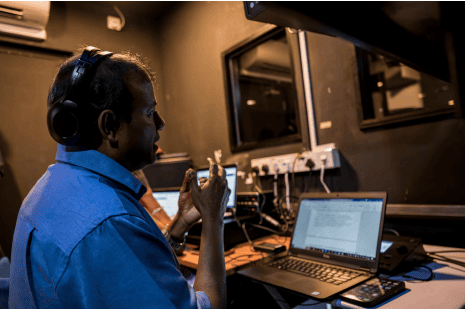
For CMT sessions offering real-time English translation through simultaneous interpretation or AI-assisted tools, Festivalgoers simply scanned a QR code at the start to listen to the live translation. Photos credit: Arts House Group.
This year marked the first time over 20 CMT sessions such as The Power of Non-Fiction Writing in Our Contemporary World, Festival Keynote Talk: Zakaria Ali – Pushing the Boundaries of Aesthetics between Eras and A Novel Journey: History and Future Directions of Singapore Tamil Novels, included real-time live translation into English via both simultaneous interpretation and AI-assisted translation. This expanded accessibility drew in new and multilingual audiences, enriching conversations across languages and cultures.
Festivalgoer Vivian Loy, who attended a Chinese programme with simultaneous interpretation said. “As a festival attendee, I found the live translations immensely helpful. They were accurate and captured the nuances of the discussion, which made the session easy to follow. I also liked how simple it was to screenshot key excerpts on my phone, instead of scribbling notes. It let me stay fully present with the speaker and enriched the whole experience.”
Katapella: Where Language Meets Harmony was a captivating choral showcase that blended soaring harmonies with expressive choreography, as performers brought every word to life with infectious energy and passion. Guest curator for Malay programmes Ilyia Kamsani shared, “One of the most rewarding parts was meeting like-minded individuals from different backgrounds who share the same passion of building a vibrant literary community. Moments like these remind me what literature is really about – connecting people on a human level and nurturing our shared sense of humanity.”
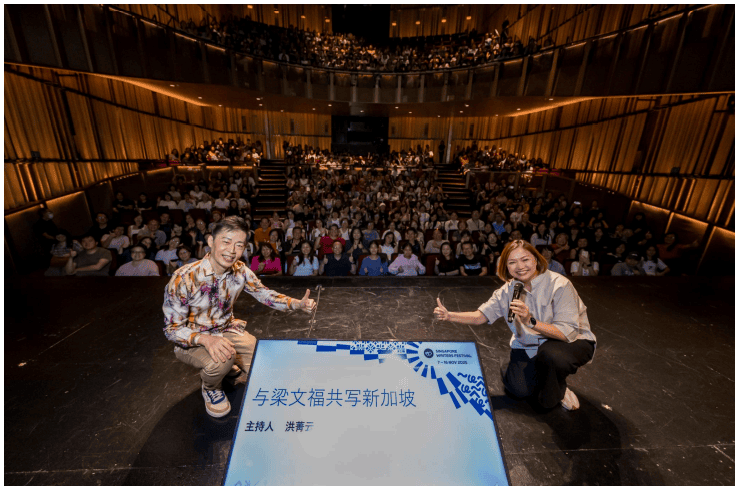
To commemorate Singapore’s 60th year of independence, Dr Liang Wern Fook reflected on how his writing has evolved alongside the nation’s growth in Writing Singapore with Liang Wern Fook, which played to a full house at Victoria Theatre. The Festival also expanded its reach to new audiences through a Chinese food series, A Feast of Words & Flavours, curated by guest curator for Chinese programmes Yap Seow Choong and Tan Pin Yen.
Yap Seow Choong shared that the team had spent considerable time working closely with both writers and chefs to develop dishes that would never appear on a regular menu. He also noted his surprise at the number of attendees who had flown in from overseas specifically to attend the programmes. “Across all five fully booked sessions, it was clear that participants were not only eating well but also listening with joy. That response affirmed my intention: to bring literature into everyday life, to let people savour it slowly and intimately. The other programmes were designed with the same spirit in mind—crafting immersive ways for audiences to experience literature rather than simply consume it,” he added.

The Festival also deepened its commitment to diversity through programmes such as Tech Talks: Using Tech Solutions to Create Inclusive Spaces, Visual Storytelling with Procreate: Digital Art Workshop with Isaac Liang, and Letters Out of Order: Writing about Dyslexia. Workshops and talks featured writers and presenters from all walks of life, including migrant workers and individuals who have navigated different access needs or are from underserved communities, offering space for stories that are often less visible in mainstream settings.

The SG60 Homage track honoured individuals, groups, movements and ideas that significantly contributed to Singapore’s literary scene over the years. The touring exhibition Behind the Pages: Evolution of Publishing in Singapore welcomed audiences to discover Singapore’s rich publishing history in all four official languages from the 1960s through to the present day. Meanwhile, in the panels Bookprints of a Nation: Singapore Publishing Across Languages and Sing Lit on the Global Stage – Publishers’ Edition, speakers reflected on how publishers have shaped Singapore’s literary landscape, from nurturing local readerships across languages to helping Singaporean voices find resonance on the global stage.
Broadened Reach and Increased Community Connections
This year’s Festival expanded its reach with community engagement and a strong take-up of the SG Culture Pass, which attracted many first-time visitors and widened SWF’s audience base, recording more than 30% growth in Festivalgoers.
A 29-year-old tourist and first-time Festivalgoer shared, “The programming is fantastic. Each day, at each time, there were multiple talks and panels I wanted to attend. I was impressed with the variety and range of themes and topics discussed. Also loved the bookstore selection and discovering more Southeast Asian and local Singaporean writers.”
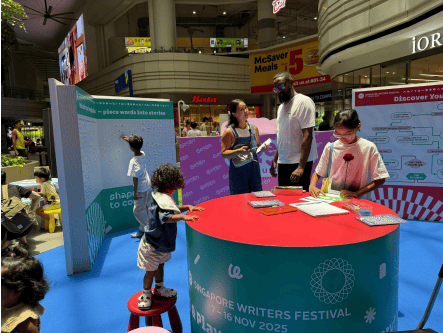
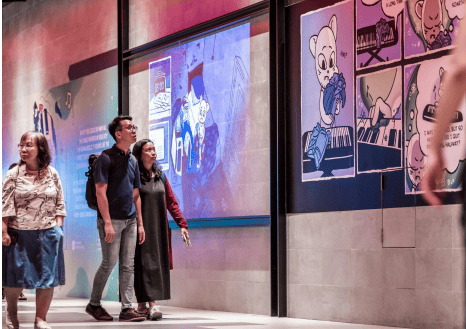
Image left: SWF Encounters saw travelling pop-ups to heartland malls across Singapore. Image right: Commuters pause to view That Time I Cringed So Hard I Ended Up on These Walls exhibition at the Funan Underground Pedestrian Link. Photos credit: Arts House Group
Community engagement grew through Stories Across Generations, Snippets of the Future and a series of outreach pop-ups at Bedok Public Library, Westgate, Sengkang Grand Mall and Funan, featuring activities by Closetful of Books and other partners. These initiatives brought the literary arts into the heart of neighbourhoods, transforming everyday MRT stations into lively literary spaces, creating opportunities for families and new audiences to connect with stories, writers and the joy of reading beyond traditional festival venues.
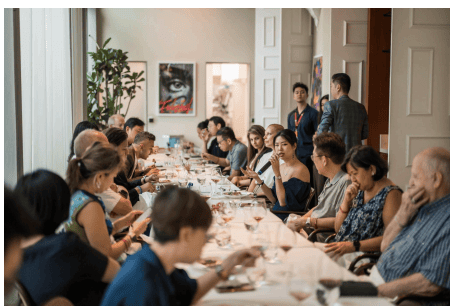
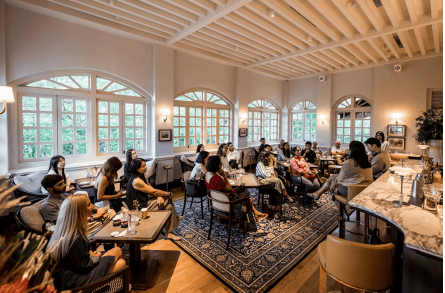
Image left: The Salon with Marylyn Tan and F.H. Batacan at Brasserie Astoria. Image Right: The Salon with Balli Kaur Jaswal at The Pineapple Room in Capella Singapore. Photos credit: Arts House Group
A new series this year was The Salon series which brought a convivial, social layer to the Festival. Presented with Capella Singapore, Brasserie Astoria and Belimbing, these sold-out sessions paired lively conversation with artisanal food and drinks. Writers such as renowned food author and cook Fuchsia Dunlop connected closely with audiences, making for an inviting, relaxed and immersive literary experience.
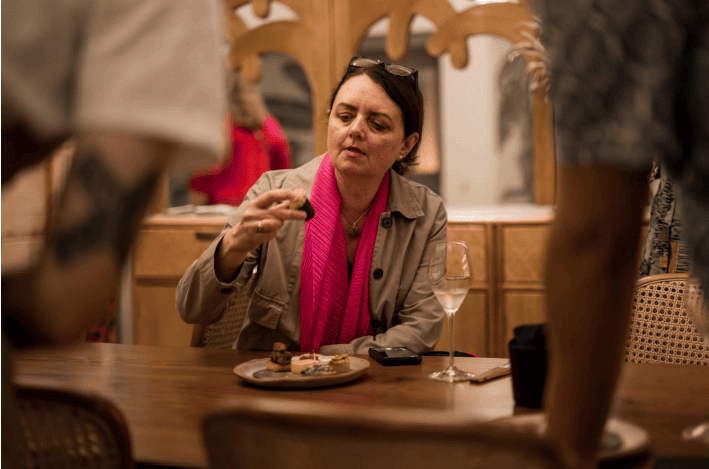
Acclaimed food writer Fuchsia Dunlop reflected on her festival experience, “It has been an honour and a joy to participate in SWF 2025, from the warm welcome from the Festival team to the diverse local and international speakers and thought-provoking audience questions. The location of the Festival was perfect, and it was fun taking part in a panel discussion in the old parliament chamber! As a food writer, I was also happy to have the chance to explore the local gastronomic scene and learn more about Singapore’s history as a crossroads of cuisines and cultures.”
Executive Director of Arts House Group Sharon Tan said, “This year’s Festival has shown how stories can open doors, bridge worlds and welcome new communities into a shared space of curiosity and exchange. We are grateful to our partners, the remarkable writers and presenters who offered their insight, and the many Festivalgoers whose enthusiasm shaped such a warm and memorable celebration of the written word. As we continue to champion Singapore’s literary landscape, AHG remains committed to nurturing local and emerging voices, deepening community bonds and strengthening the global conversations that our city’s stories inspire.”
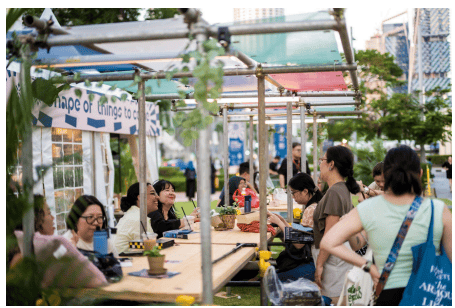
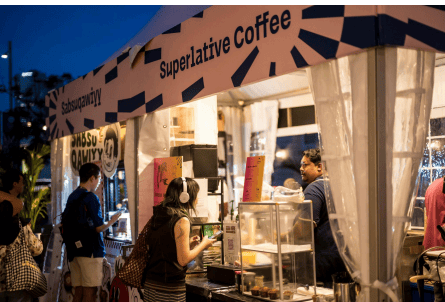
Festival vibes with books, conversations and F&B, creating a lively space where literature meets lifestyle. Photos credit: Arts House Group
Beyond the Festival
As SWF 2025 draws to a close, it leaves behind a wealth of dialogue, inspiration and discovery for the next generation of readers and writers. Audiences can revisit selected highlights through digital session recordings, explore the Stories Across Generations online exhibition and visit Behind the Pages: Evolution of Publishing in Singapore. The Snippets of the Future exhibition will also be displayed in selected participating schools such as Ngee Ann Secondary School where audiences are also invited to write their own “snippets”. Both Snippets of the Future and Behind the Pages: Evolution of Publishing in Singapore will feature accompanying online exhibitions, extending the Festival experience beyond physical spaces. For additional highlights and further information on the post-Festival programmes, please refer to Annex A.
It was also announced by MCCY that SingLit books will be eligible for SG Culture Pass credits from 1 March 2026, with the aim of making the SG Culture Pass a key catalyst in helping Singaporeans discover and embrace local literature.
SWF 2026 will take place from 13 to 22 November 2026. The theme, Hidden in Plain Sight, invites Festivalgoers to question their assumptions about what’s obvious and obscured in this era of shifting narratives, reflecting on how the notion of “truth” can be (de)constructed, reinterpreted or concealed in literature and beyond.
Follow #sgwritersfest and #SWF2025, on:
● Website: www.singaporewritersfestival.com
● Facebook: www.facebook.com/sgwritersfest
● Instagram: www.instagram.com/sgwritersfest
● YouTube: www.youtube.com/user/sgwritersfest
● Telegram: https://t.me/sgwritersfest Please click here to access the visuals.