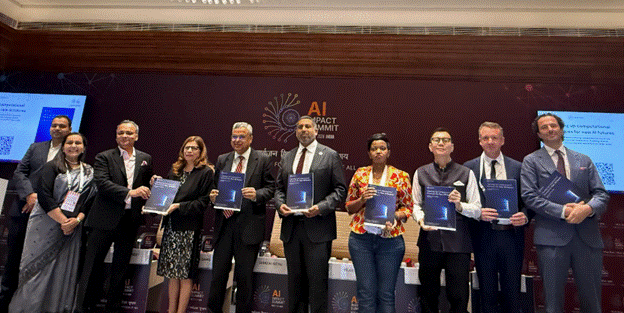
Leaders at the India AI Impact Summit 2026 said AI growth must focus on public interest goals such as healthcare, education and agriculture. They called for shared infrastructure, policy support and skill development to make AI more inclusive.
A new report on public-interest AI was launched at the India AI Impact Summit 2026, with experts urging governments and institutions to ensure AI resources are used for clear social goals.
The session, titled “Building Public Interest AI: Catalytic Funding for Equitable Access to Compute Resources,” featured senior government officials, global AI experts and philanthropic leaders. The event focused on how affordable access to computing power can help countries in the Global South use AI for development.
Dr. Saurabh Garg, Secretary, Ministry of Statistics and Programme Implementation, launched the working report “Opening Up Computational Resources for New AI Futures.” He said AI will shape the future, but its success must be measured by whether it is fair, inclusive and focused on public welfare.
He said the key issue is not just whether AI can transform the world, but whether that transformation benefits everyone equally.
Martin Tisné, CEO of AI Collaborative, warned that simply building data centres is not enough. He said countries may create AI infrastructure, but without proper use and access, these facilities may remain underused.
Vilas Dhar, President of the Patrick J. McGovern Foundation, said scaling AI for users and creators is not only a technology issue but also a policy challenge. He stressed the need for stronger institutions that can connect funding, policy and real-world deployment.
Shikoh Gitau, CEO of Qhala, said AI infrastructure should be built around practical goals in healthcare, education and agriculture. She said once clear use cases are identified, the need for compute resources becomes easier to plan and manage.
Shaun Seow, CEO of Philanthropy Asia Foundation, highlighted the need for shared access models, concessional pricing and better digital skills. He said Asia’s skills gap remains a major challenge in fully using AI’s potential.
The session concluded that public and philanthropic funding, shared AI infrastructure and better governance can help make AI a global public good.
Source: PIB