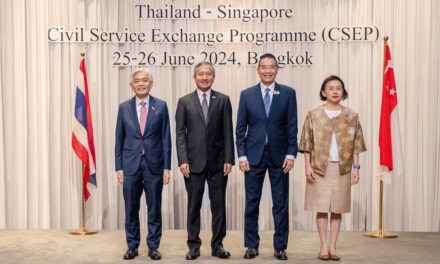

Singapore and Thailand have opened applications for carbon credit projects under a new bilateral agreement, aiming to support climate action and sustainable development.
Singapore and Thailand have officially launched a new application call for carbon credit projects under their bilateral Implementation Agreement on 31 March 2026. This marks Singapore’s fifth such initiative, following similar project calls with Ghana, Peru, Bhutan and Rwanda, and reflects growing international cooperation in climate action.
The initiative allows authorised projects in Thailand to generate carbon credits aligned with the Paris Agreement, particularly under Article 6, which supports global emissions reduction through cooperation. These projects are expected to expand carbon mitigation opportunities while contributing to sustainable development, including job creation and environmental improvements for local communities.
Under Singapore’s International Carbon Credit framework, the approved credits may be used by eligible companies to offset up to 5 percent of their taxable emissions, supporting businesses in managing their carbon footprint while meeting regulatory requirements.
Interested applicants can submit proposals for projects in Thailand, which will be reviewed jointly by both governments on an ongoing basis. The application process consists of three stages, starting with a project concept submission, followed by a detailed design and validation phase, and ending with the issuance of carbon credits after independent verification.
To ensure environmental integrity, all projects must meet strict eligibility criteria set by Singapore, including requirements that emissions reductions are real, measurable, verified, permanent and not double-counted. Approved methodologies span sectors such as renewable energy, agriculture, waste management, transport and forest conservation.
The Implementation Agreement between Singapore and Thailand, signed in August 2025, provides a legally binding framework for the transfer of high-quality carbon credits between the two countries. It also supports broader climate goals, including national emissions targets and global efforts to reduce greenhouse gases.
This collaboration forms part of Singapore’s wider strategy to achieve net zero emissions by 2050 through international partnerships, especially given its limited domestic capacity for large-scale emissions reduction.
Source: MTI