By H.E. Mohammad Abdullah S. Alghamdi,
Ambassador of the Kingdom of Saudi Arabia to Singapore
For many in Asia, the Red Sea may seem geographically distant. Yet, recent disruptions to shipping routes and energy flows have underscored a strategic reality that is becoming increasingly difficult to ignore: stability in the Red Sea is no longer only a Middle Eastern concern. It is becoming an integral component of Asia’s economic security.
This reflects a broader transformation in the geography of global commerce. As trade networks become more interconnected and supply chains more vulnerable to disruption, Southeast Asian economies can no longer view maritime security through the lens of the Indo-Pacific alone. The resilience of shipping corridors stretching from the Gulf and the Red Sea to the Strait of Malacca now plays an increasingly important role in sustaining Asia’s trade, energy security and long-term economic growth.
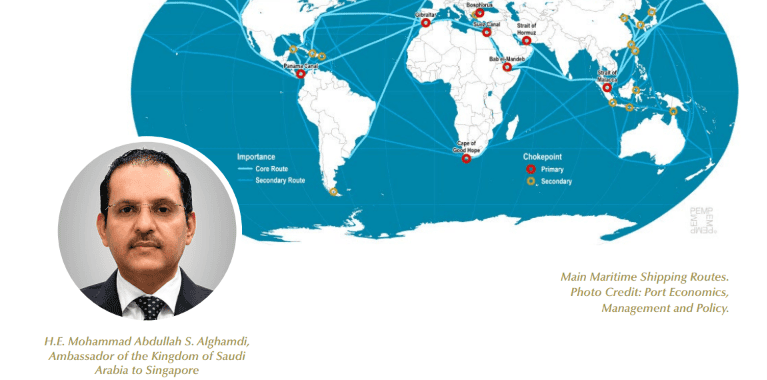
From the Strait of Hormuz to the Strait of Malacca, the world’s maritime routes are deeply interconnected. Disruptions in one part of this network inevitably affect the others. For economies across Asia that depend heavily on trade, energy imports and maritime shipping, the consequences are immediate: higher freight costs, supply chain disruptions, rising insurance premiums and greater economic uncertainty. This makes it all the more important to keep maritime chokepoints open, uphold freedom of navigation and preserve the continuity of energy and trade flows.
Today, Asia receives the majority of energy exports passing through Gulf shipping lanes. The stability of these maritime corridors is therefore as much an Asian interest as it is a regional one. It also reinforces the importance of safeguarding the security and continuity of global energy supplies, particularly during periods of heightened uncertainty. Developments in the Red Sea are no longer confined to the Middle East; they are increasingly linked to the stability of global commerce and international trade flows.
Recent years have also highlighted the growing importance of resilience in global trade and energy networks. Efficiency alone is no longer sufficient. Increasingly, attention is being placed on diversification, infrastructure development and the ability to sustain trade and energy flows during periods of crisis.
In this context, Saudi Arabia’s western coastline is emerging as an increasingly important anchor for resilient global connectivity. The Kingdom’s investments in its Red Sea ports, logistics infrastructure and transport networks — alongside the East-West Pipeline linking the Gulf to Yanbu on the Red Sea — contribute to greater reliability in energy and trade flows between the Middle East and Asia, especially during periods of heightened uncertainty.
The importance of these projects extends beyond their national dimension. Their impact is also felt across Asian economies that rely heavily on stable supply chains, the security of energy supplies and maritime commerce. At the same time, the growing logistical and commercial connectivity between the Gulf and Asia reflects a broader transformation in relations between the two regions. These ties are no longer defined solely by energy exports, but increasingly by infrastructure, investment, logistics and long-term economic integration.

Importantly, these developments should be viewed through the practical lens of economic resilience and shared connectivity. At its core, the issue is about safeguarding the continuity of global commerce and ensuring that maritime routes remain open, stable and predictable.
For policymakers in Southeast Asia, this reality carries an important implication. Maritime resilience can no longer be understood solely in terms of developments within Asia’s immediate neighborhood. The security of trade and energy flows increasingly depends on cooperation across a wider network of maritime partners, extending from Southeast Asia to the Gulf and the Red Sea.
For Southeast Asia’s maritime and trading economies, the current moment presents an opportunity to deepen cooperation with Gulf partners in areas of shared interest, including maritime security, supply chain resilience, the security of energy supplies and logistics connectivity.
In a world marked by growing uncertainty, resilience has become the new foundation of global trade. As global commerce becomes increasingly interconnected, Asia’s long-term economic security will depend not only on developments within the Indo-Pacific, but also on the resilience of maritime corridors linking Southeast Asia to the Gulf and the Red Sea.