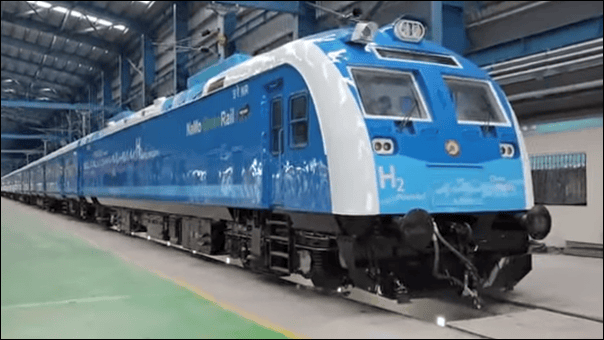
India inaugurated its first indigenous hydrogen-powered train on the Jind–Sonipat section of Northern Railway, advancing clean rail transport under the National Green Hydrogen Mission.
India inaugurated its first indigenous hydrogen fuel cell-powered train on 17 July 2026, marking a milestone in the country’s transition towards clean and sustainable rail transportation. The train began operations on the Jind–Sonipat section of the Northern Railway, demonstrating the viability of hydrogen-powered mobility while supporting India’s broader environmental and energy transition objectives.
The project was developed as a pilot initiative by Indian Railways in accordance with technical specifications prepared by the Research, Design & Standards Organisation (RDSO). Designed and manufactured entirely in India, the hydrogen-powered train forms part of the country’s efforts to advance indigenous technology development under the Atmanirbhar Bharat initiative. Alongside the train itself, the project includes dedicated hydrogen storage, refuelling and operational infrastructure to support safe and efficient rail operations.
The inauguration marked India’s entry into a select group of countries exploring hydrogen-powered rail transportation, joining nations including Germany, Japan, China and the United States. As hydrogen rail technology remains in its early stages globally, the initiative is expected to provide operational experience that could inform future applications across India’s railway network.
The hydrogen-powered train consists of a 10-coach trainset powered by a 1,200-kilowatt hydrogen fuel cell propulsion system. Approved to operate at a maximum speed of 75 kilometres per hour, with a design speed of 110 kilometres per hour, the train has a passenger capacity of approximately 2,600. It connects Jind Junction, Gohana Junction and Sonipat while serving several intermediate stations along the route.
The train generates electricity onboard through a Proton Exchange Membrane Fuel Cell (PEMFC), which produces power by combining hydrogen and oxygen. The process emits only water vapour and heat, eliminating carbon emissions associated with conventional diesel-powered locomotives. Indian Railways stated that hydrogen offers a significantly higher energy density than diesel while supporting lower maintenance requirements and reduced environmental impact.
To support operations, Indian Railways established the country’s largest railway hydrogen storage and refuelling facility in Jind, Haryana. The indigenous facility has the capacity to store nearly 3,000 kilograms of hydrogen and has received the necessary licence from the Petroleum and Explosives Safety Organisation (PESO). The hydrogen ecosystem was developed in accordance with internationally recognised standards, including NFPA-2 and the ISO 19880 Series, and underwent an independent third-party safety assessment by TÜV SÜD, Germany.
Indian Railways also introduced a comprehensive operational and safety framework for the project. The system incorporates hydrogen leak detection, flame monitoring, continuous ventilation, automatic hydrogen supply shut-off mechanisms and real-time system health monitoring. Dedicated maintenance facilities, trained personnel, standard operating procedures and continuous refuelling supervision have also been established to support reliable operations during the pilot phase.
The initiative supports India’s National Green Hydrogen Mission and contributes to the country’s long-term net-zero carbon emission objectives. Beyond introducing a new train, the project establishes the infrastructure, technical capabilities and operational procedures required to support the future deployment of hydrogen-powered rail transportation across the Indian railway network.
Indian Railways is expected to continue evaluating the pilot project to validate operational performance, maintenance practices and safety systems. The experience gained through the initiative is anticipated to support future expansion of hydrogen-powered mobility as part of the country’s ongoing railway modernisation and sustainable transport agenda.
Source: PIB Delhi