Kazakhstan seeks Korean partnerships in logistics, artificial intelligence, data centres and semiconductors.
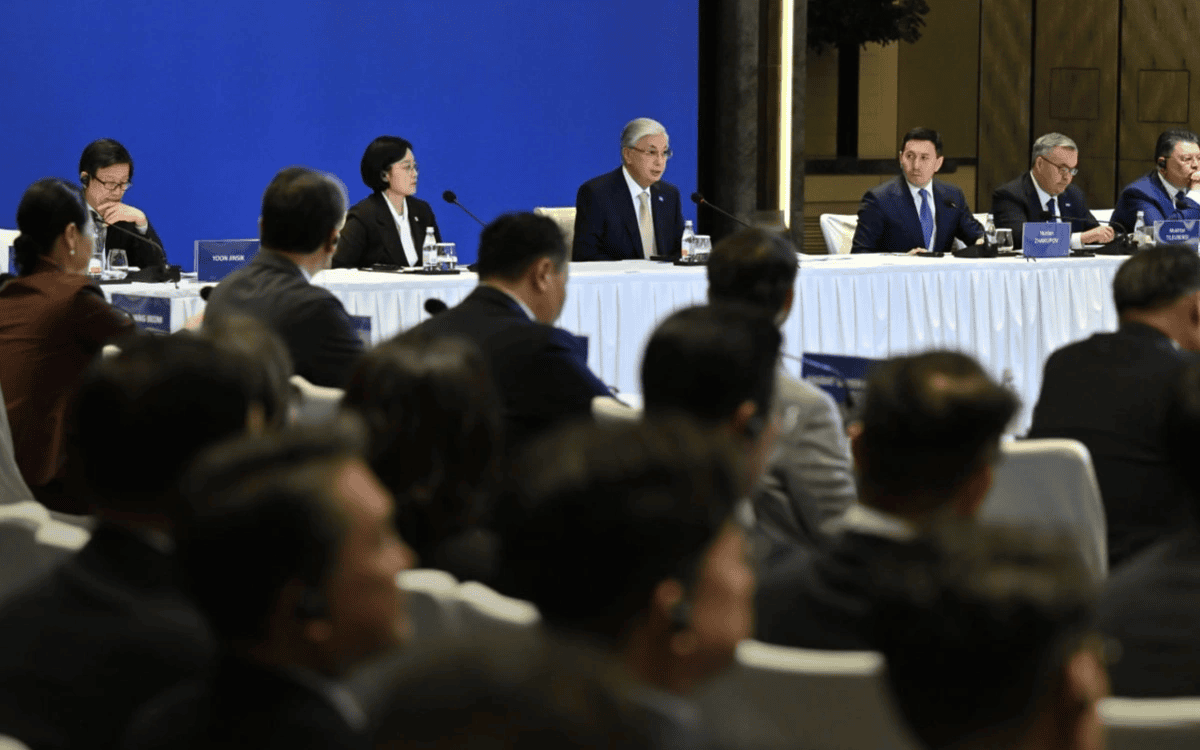
President Kassym-Jomart Tokayev outlined Kazakhstan’s plans to develop its transport, logistics and technology sectors at the opening of the Kazakh-Korean roundtable meeting in Seoul. The President said Kazakhstan aimed to use its position between Europe and Asia to expand transport and logistics infrastructure, while developing the country as a computing hub in Central Asia.
The roundtable provided an opportunity for Kazakhstan and South Korea to discuss cooperation in logistics, artificial intelligence, data-centre infrastructure and advanced technology. President Tokayev said Kazakhstan was investing in railways, highways, seaports, terminals and related infrastructure to increase the capacity, speed and reliability of the Middle Corridor.
President Tokayev called for greater South Korean participation in developing the Middle Corridor. He welcomed Korean logistics companies, including CJ Logistics and LX Pantos, which were already developing logistics centres, multimodal terminals, warehouse complexes and digital solutions for supply-chain management in Kazakhstan.
To support further projects, President Tokayev proposed establishing a Kazakh-Korean joint venture to advance new logistics initiatives and facilitate the transit of Korean cargo through Kazakhstan. He also noted that Kazakhstan’s Shin-Line and Lotte Global Logistics were pursuing partnership plans in the sector.
The President also highlighted opportunities in artificial intelligence and new technologies, stressing the importance of human capital to Kazakhstan’s AI strategy. He referred to cooperation with Seoul National University of Science and Technology on the joint creation of Kazakhstan’s first Institute of Artificial Intelligence.
President Tokayev further discussed Kazakhstan’s developing data-centre ecosystem, including the Data Valley project in the Pavlodar region. The ecosystem was planned with capacity of up to one gigawatt, scalable expansion, dedicated land plots and integration with national supercomputing facilities.
“Our goal is to position Kazakhstan as the main computing hub of Central Asia and a bridge between Europe and Asia,” President Tokayev said, adding that the plans offered opportunities for Korean technology companies.
He also said Kazakhstan was ready to expand exports of materials and components for microelectronics and semiconductor production, noting potential cooperation with Samsung Electronics and SK Hynix. Earlier in his speech, President Tokayev had invited South Korean companies to expand production in Kazakhstan.
Source: Kazinform