Leaders from Asia, Africa, Europe, Latin America and the Middle East gathered for GFTN’s Insights2040 Annual Meetings. The message from the opening: global finance will soon run on a new rulebook.
Singapore, 16 November 2026. As technology reshapes economies and traditional financial systems face new pressures, policymakers, central bankers, regulators and industry leaders from across the world have gathered in Singapore for the Insights2040 Annual Meetings. Organised by the Global Finance & Technology Network (GFTN), the two-day, invitation-only meetings are held at Sands Expo & Convention Centre and open Singapore FinTech Festival (SFF) week. Participants have travelled from Latin America, Africa, Europe, the Middle East and across Asia.

Insights2040 is GFTN’s year-round platform for building the evidence base and implementation pathways that make the financial system more efficient, more resilient and more inclusive. The Annual Meetings, formerly known as the Insights Forum, are where a year of that work comes together. GFTN describes its role as a neutral convener and trusted bridge between regulators, central banks, financial institutions and innovators.
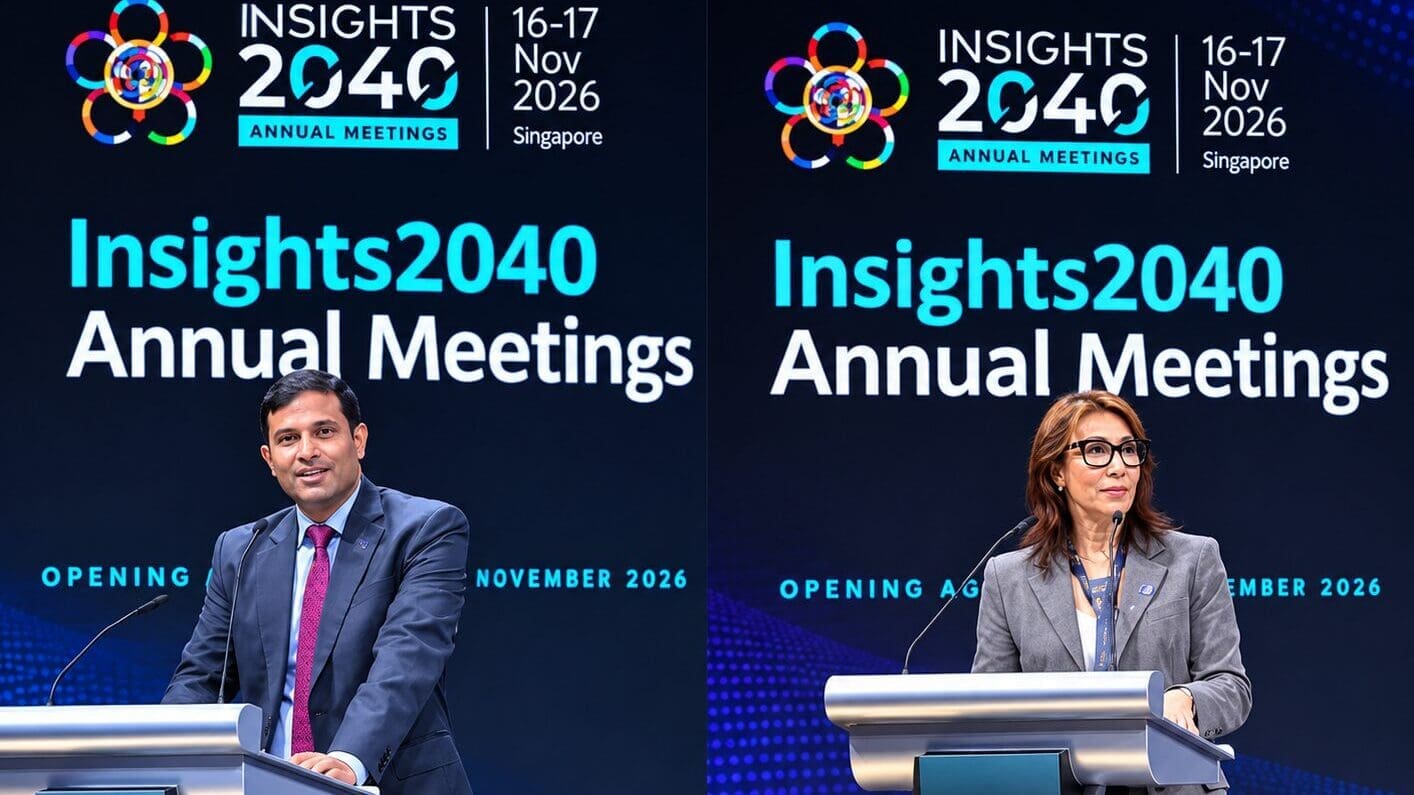
Opening the meetings, Anthony Thomas, Group Chief Operating Officer of GFTN, told delegates that the financial world is entering a period of profound change. “Very soon global finance will run on a new rulebook,” he said, adding that it is being rewritten on five fronts at the same time: technology, geoeconomics, capital, talent and policy.
His colleague Maha El Dimachki, Managing Director, Policy & Skilling at GFTN, then stressed that discussions must lead to tangible outcomes. “Understanding the changes ahead is only the starting point,” she said.
Returning to the five fronts, Mr Thomas said each comes with its own question, and the figures he cited in the opening address show why:
Technology: Nearly US$21 billion in cybercrime losses were reported to the FBI last year, representing an increase of more than a quarter in just one year (FBI Internet Crime Report 2025). Meanwhile, the global tokenised asset market is projected to reach US$5.5 trillion by 2030 (Citi Institute), while the European Union has urged member states to begin transitioning to post-quantum cryptography by the end of this year. The challenge is to harness these emerging technologies while staying ahead of those who may misuse them.
Geoeconomics: Trade between developing economies now accounts for nearly 28 per cent of global merchandise trade, almost double its share from 20 years ago, according to the WTO. As global trade routes evolve, the financial networks responsible for financing and settling these transactions must adapt accordingly.
Capital: AI-connected firms account for approximately 45 per cent of the S&P 500’s market capitalisation, while the world’s largest technology companies are expected to spend around US$670 billion on capital expenditure this year, according to figures cited from Yahoo Finance and the Wall Street Journal. This raises an important question: can productivity gains and revenue growth sustain an investment boom of this scale?
Talent: Employers surveyed by the World Economic Forum expect 39 per cent of workers’ core skills to change by 2030. Financial institutions must therefore accelerate workforce development and equip their employees with the skills needed to remain competitive.
Policy: Although 82 per cent of banks use generative AI, only 18 per cent have fully operational and embedded governance processes for AI models, according to FT Longitude, SAS and Microsoft. This highlights the need for governance and risk frameworks to evolve alongside technological adoption while maintaining trust and resilience.
Under the theme “Insights to Action”, more than 50 roundtables, workshops and launchpads will work through six themes: accountability in agentic AI systems, scaling tokenised markets, shaping tomorrow’s innovation, payments frameworks, sovereignty and resilience, and preparing finance for the quantum era.
Ms El Dimachki then set out how GFTN is turning the themes into action. On AI, it is working across ASEAN with the ABA and partners on a baseline for AI governance in banking, and with Financial Innovation for Impact, led by Bryan Zhang, on how regulators can use AI in supervision. The methodology of the Fintech Regulatory Futures Index, announced in June with The Fintech Foundation, is now open for review. In India’s Odisha state, the first graduates of the FinTech and InsurTech certificate, run under the BharatNetra initiative with the Government of Odisha and the National University of Singapore’s Asian Institute of Digital Finance, include more than 60 who have secured internships or job offers. One student team presented its project to MUFG in Tokyo and received funding to take it forward.
On tokenisation, a new report identifies eight frictions raised by the private sector, with a capacity programme and digital sandbox planned for the Point Zero Forum in Zurich next year. On payments, Project Lúmina is exploring links between the instant payment systems of Chile, Colombia, Paraguay, Peru and Uruguay with the Latin American Reserve Fund. In Africa, GFTN has published a digital public infrastructure gap assessment for Namibia and is working with the Ghana Interbank Payments and Settlement System, led by Clara Arthur, while contributing to the G20 roadmap for cross-border payments. On quantum, the Q-FINEX platform, built with the University of Western Australia and ST Engineering, lets financial institutions test quantum approaches on real business challenges.
Ms El Dimachki closed by quoting Madam Lagarde: “There is no pre-existing playbook for the situation we are facing today – and so our task is to draw up a new one.” Her own invitation to delegates was simple: “Let’s write it together.”

Beyond the roundtables, the Insights Exchange area gathered technology and financial firms around the meetings. According to the Day 1 floor plan, exhibitors include Airwallex, Amazon, Fireblocks, Giesecke+Devrient, GCash, HSBC, Monad Foundation, NTT Data, Paxos and RegGenome, alongside Binance, Circle, Hitachi, Mastercard, Tencent, Tether and Thought Machine. Their displays echoed the meeting’s themes, from Hitachi’s message that finance needs a new playbook that no single company can write alone, to Circle’s pitch for open infrastructure for the global digital economy and Monad Foundation’s blockchain built for global finance.

The meetings set the tone for SFF 2026, which runs from 18 to 20 November at the Singapore EXPO. Now in its 11th edition and organised by the Monetary Authority of Singapore (MAS) and GFTN with the Association of Banks in Singapore, the festival takes the theme “The Coming Rewiring of the Financial System: New Risks. New Rules. New Growth”. SFF 2025 drew more than 70,000 attendees from 142 countries and about 1,000 speakers, and this year’s edition expects over 600 sponsors and exhibitors and more than 40 international pavilions across five halls.
New this year are the 12th Global SME Finance Forum, run with the World Bank Group’s SME Finance Forum, an India Pavilion, and a GFTN and SEGA Go-Global Pavilion featuring 30 technology companies from Shanghai and Shenzhen. MAS says over 20,000 pre-scheduled meetings are expected through SFF MeetUp.
Kenneth Gay, MAS Chief FinTech Officer, said that “innovation goes hand in hand with trust and resilience”, while GFTN Group CEO Sopnendu Mohanty said that “Global finance is undergoing a structural transformation driven by five interconnected forces”.

For Singapore, Insights2040 reinforces its position as a trusted meeting point for governments, financial institutions and innovators seeking practical solutions to shared global challenges.
Source: GFTN