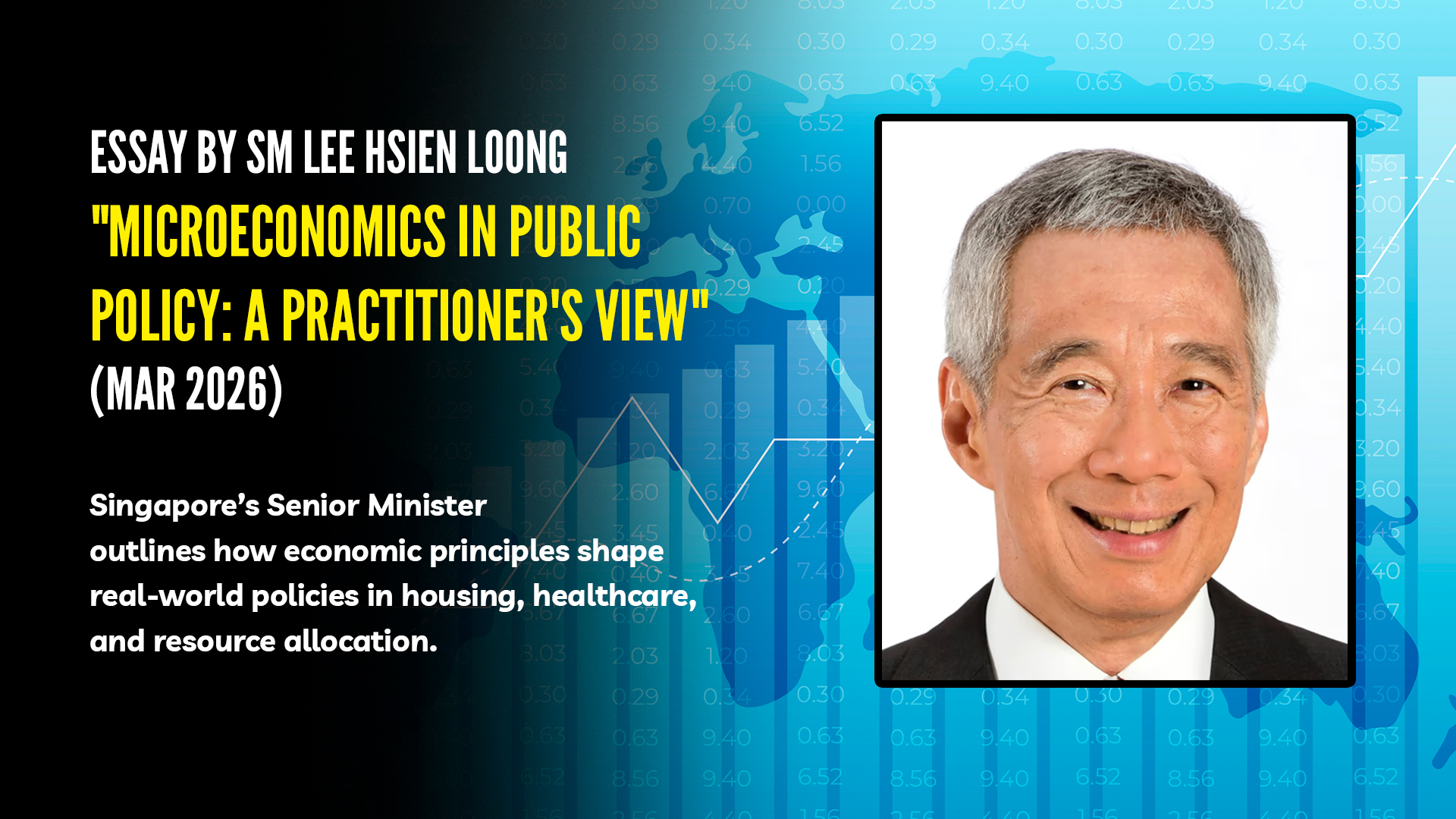
Singapore’s Senior Minister outlines how economic principles shape real-world policies in housing, healthcare, and resource allocation.
Senior Minister Mr Lee Hsien Loong published an essay titled “Microeconomics in Public Policy: A Practitioner’s View” in the Singapore Economic Review Journal on 31 March 2026.
In the essay, Mr Lee explains how governments can build and manage a strong economy using economic principles. He refers to classical economist Adam Smith, noting that while early theories supported limited government roles, modern economies require more active involvement.
Mr Lee states that Singapore follows a market-based approach. Instead of relying only on government control, policies are designed to work with market forces and human behavior.
He highlights public housing as a key example. Around 80% of Singaporeans live in government-built housing, but pricing and allocation still follow market principles to ensure fairness and efficiency. He also discusses healthcare, where Singapore uses a mix of public and private systems supported by savings and insurance schemes.
Mr Lee further explains how pricing is used to manage scarce resources. Policies such as the Certificate of Entitlement (COE) for vehicles and casino entry levies help control demand and allocate resources effectively.
He also emphasizes that financial assistance works best when given as cash or vouchers. Schemes like GST vouchers and Community Development Council (CDC) vouchers allow people to decide how to spend based on their needs.
Mr Lee concludes that three key principles guide Singapore’s policies: use market forces, price scarce resources properly, and provide flexible financial support. He says these methods have helped Singapore achieve economic growth, social stability, and efficient public services.
Source: PMO