Singapore and Rwanda invite applications for carbon credit projects to support climate action and sustainable development.
Singapore and Rwanda have launched a new call for applications for carbon credit projects under their Implementation Agreement on carbon credits cooperation. The announcement marks Singapore’s fourth application call, following earlier agreements with Ghana, Peru and Bhutan.
The initiative allows project developers to apply for authorisation to run carbon mitigation projects in Rwanda. Approved projects will help reduce global emissions while supporting Rwanda’s sustainable development goals. These projects are expected to create jobs, improve access to clean water, strengthen energy security, and reduce environmental pollution for local communities.
Authorised projects can generate carbon credits that comply with Article 6 of the Paris Agreement. Under Singapore’s International Carbon Credit (ICC) Framework, these credits can be used by Singapore-based companies that pay carbon tax to offset up to 5% of their taxable emissions.
Applications will be reviewed jointly by the Singapore and Rwanda governments through a Joint Committee. The committee is co-chaired by representatives from Singapore’s National Environment Agency and the Rwanda Environment Management Authority.
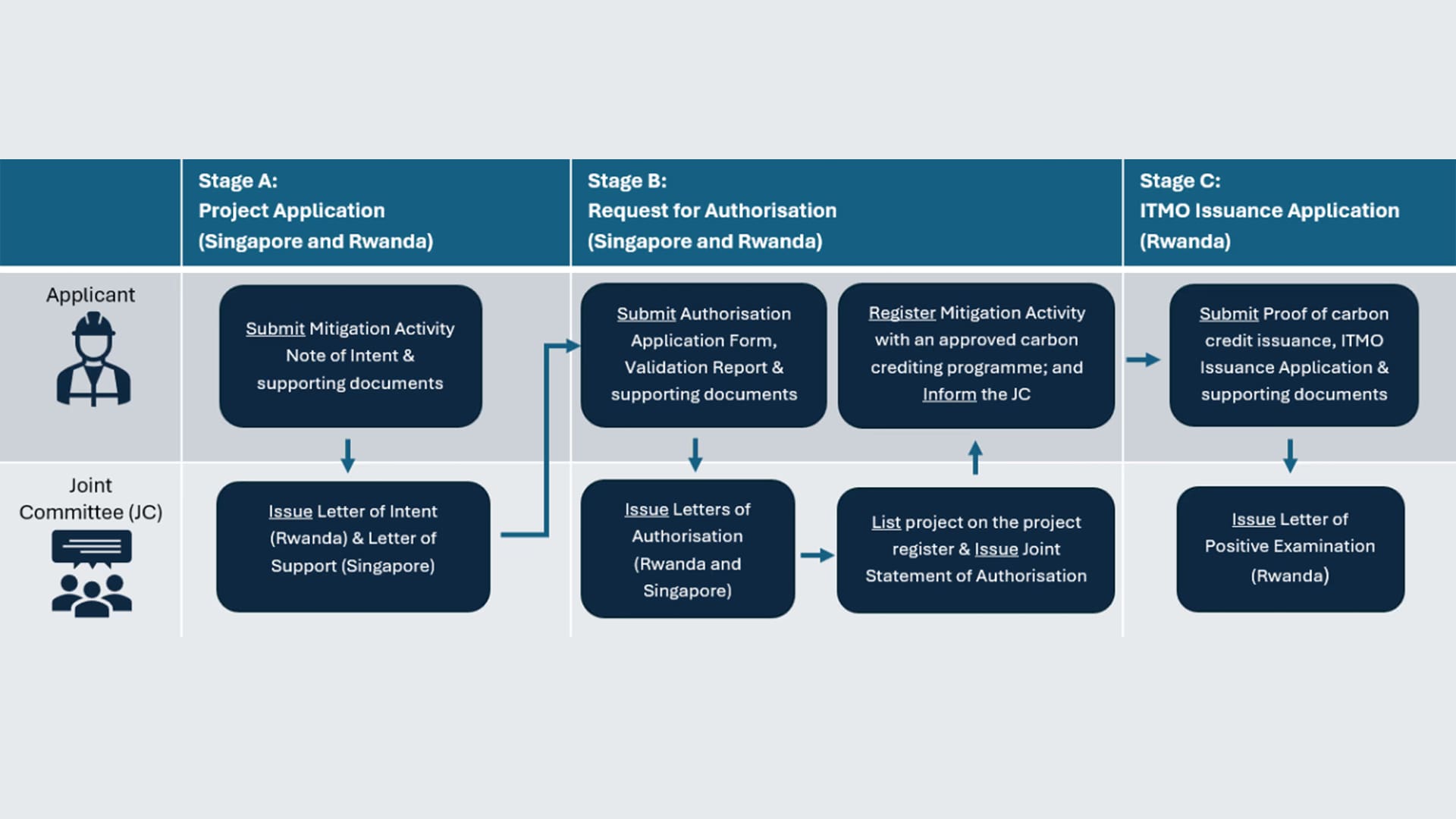
The application process has three stages. First, applicants submit a project concept note. Next, they request authorisation by providing a Project Design Document and a third-party validation report. In the final stage, verified carbon credits are issued and reviewed for corresponding adjustments under Article 6 of the Paris Agreement.
The Implementation Agreement between Singapore and Rwanda was signed in May 2025. As part of the agreement, Singapore has committed to cancel 2% of authorised carbon credits to reduce global emissions and channel 5% of the value of credits towards climate adaptation efforts in Rwanda.
The call is part of Singapore’s broader international carbon markets strategy to support its goal of achieving net zero emissions by 2050.
Source: MTI