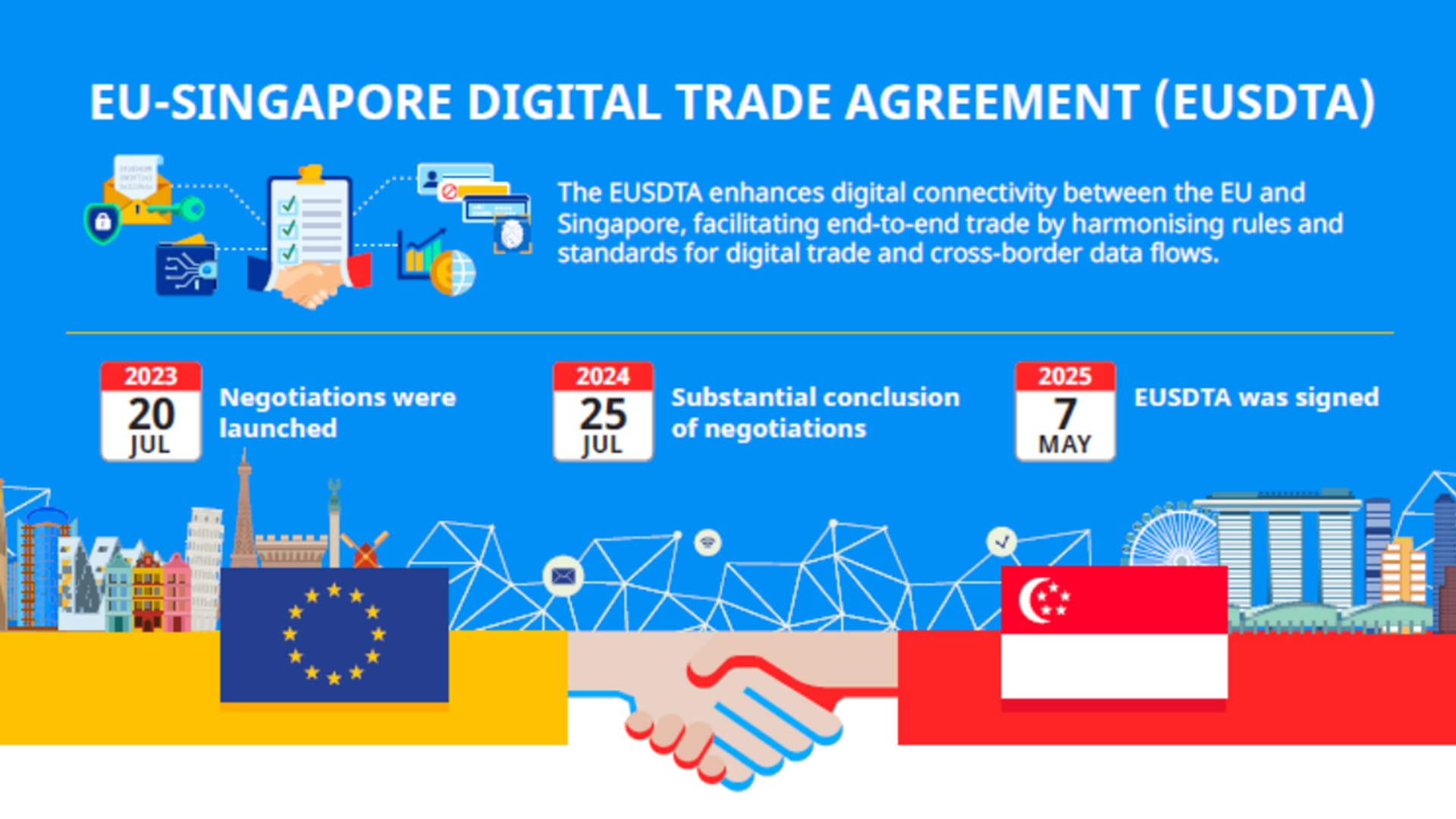
The EU-Singapore Digital Trade Agreement enters into force, boosting digital trade and data flows between both sides.
Singapore and the European Union (EU) have deepened their economic partnership with the entry into force of the EU-Singapore Digital Trade Agreement (EUSDTA). The agreement took effect today, marking a major milestone in bilateral relations.
The EUSDTA was signed on 7 May 2025 in Singapore by Minister-in-charge of Trade Relations Grace Fu and EU Commissioner for Trade and Economic Security Maroš Šefčovič. Negotiations for the agreement began in July 2023 and were concluded in July 2024.
With the agreement now in force, the EUSDTA sets high-standard rules for digital trade and supports secure cross-border data flows. It provides greater legal certainty for businesses and consumers operating in the digital economy. The agreement also promotes interoperability between Singapore’s and the EU’s digital frameworks, while strengthening consumer protection and personal data safeguards.
Minister-in-charge of Trade Relations Grace Fu said Singapore welcomed the swift entry into force of the agreement. She noted that the EUSDTA is Singapore’s largest bilateral digital economy agreement to date, covering all 27 EU Member States. She added that the agreement demonstrates both sides’ commitment to a modern, open, and rules-based digital economy, and positions Singapore and the EU for continued growth amid global economic challenges.
The EUSDTA builds on the strong economic relationship between Singapore and the EU and complements the EU-Singapore Free Trade Agreement, which entered into force in 2019. The EU is currently Singapore’s fifth largest goods trading partner and second largest services trading partner. In 2025, bilateral goods trade exceeded S$100 billion, while trade in services surpassed S$110 billion in 2023. More than half of services trade between Singapore and the EU is now digitally delivered.
Investment ties between both sides remain strong, with the EU being Singapore’s second largest foreign investor and second largest overseas investment destination.
Source: MTI