Over 36 hours at Singapore Management University, 120 students in mixed-country teams created everyday tools for hawkers, farmers, seniors and businesses.
Singapore-India Hackathon (SIH) event has just concluded with Winning student teams gather on stage with Piyush Gupta, Chairman of the SMU Board of Trustees (centre, in striped tie), at the Singapore–India Hackathon 2026 Award Ceremony on 17 November 2026. From helping street vendor recover income lost during bad weather to helping farmers plan crops around buyer demand, students from Singapore and India came together at Singapore Management University (SMU) from 15 to 17 November 2026 for the fourth Singapore–India Hackathon (SIH). Working in 20 mixed-country teams, 120 university and polytechnic students spent 36 hours turning rough ideas into working prototypes under the theme “Build a Better Future”.
First proposed in 2018 by Indian Prime Minister Narendra Modi to Singapore’s then-Prime Minister Lee Hsien Loong, the event returned to Singapore this year after editions in India. It was organised by SMU’s Institute of Innovation and Entrepreneurship (IIE), the All India Council for Technical Education (AICTE) and India’s Ministry of Education’s Innovation Cell, alongside TiE Singapore.
Four Tracks, Four Practical Ideas
Teams tackled real-world problems set by four partners consisting of Income Insurance, Singtel, Singapore’s Ministry of Energy, Trade and Industry (METI), and the Singapore Centre for Social Enterprise (raiSE) that is competing for S$88,000 in total prizes.
In the FinTech and InsurTech track (Income Insurance), first-place winner POINT BLANK created Payung, a bad-weather income cover for Singapore’s hawkers. When official weather readings show heavy rain, haze or extreme heat near a stall, the service automatically sends a same-day payout via PayNow without requiring any claim forms. In Emerging Technologies (Singtel), annex winner Signal built an AI tool that gathers public news and company records to help sales teams spot promising business leads and prepare outreach messages.
In Sustainability and Climate Action (METI), annex winner Holy Crop designed Farmora, a platform that helps Indian smallholder farmer groups plan what to grow based on buyer demand and local weather, while giving exporters a clearer view of upcoming harvests.
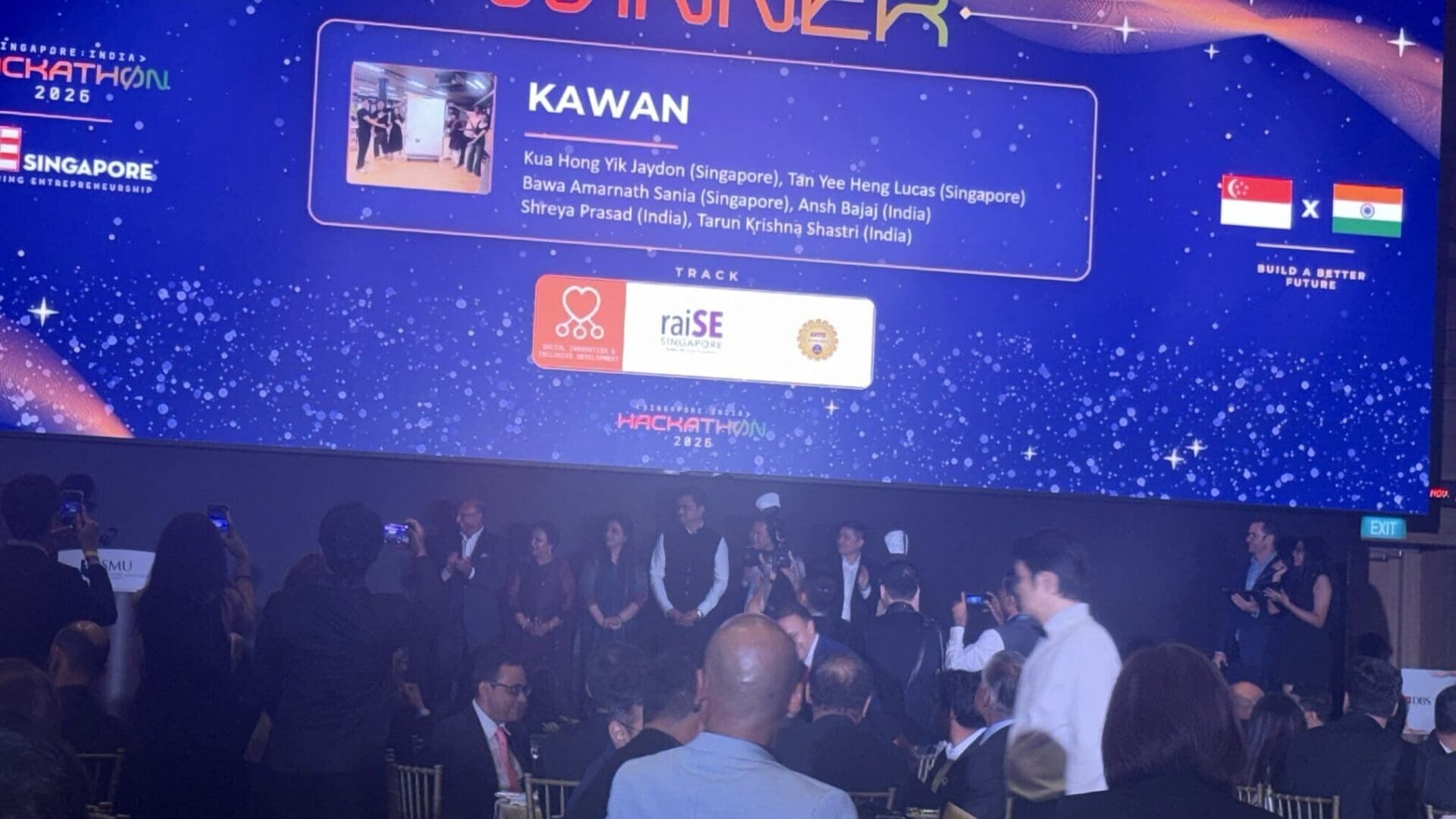
Meanwhile, in Social Innovation and Inclusive Development (raiSE), first-place winner Kawan created a community-led programme to help lower-income seniors in Singapore and India stay healthy, active and valued for their life skills.
Beyond the Competition

Outside the 36-hour sprint, students met representatives from more than 10 companies: including GIC, Singapore Airlines, Singtel and Temasek to explore internships and jobs, and attended TiECon 2026 to learn from founders and investors. Teams looking to take their prototypes further can also seek mentorship and start-up support through SMU’s Business Innovations Generator (BIG).
For SMU Board of Trustees Chairman Piyush Gupta, the event’s real strength lies in the friendships formed across borders. “Economic corridors are not built by agreements alone, they are ultimately built by people,” he said at the Gala Dinner on 17 November. Supporting that long-term link, Patrons Nupur Agarwala Bahadur and Amrish Bahadur launched a new scholarship on 15 November that will fund four past or current SIH participants to pursue master’s degrees at SMU.
By pairing hands-on teamwork with industry mentorship and study pathways, SIH 2026 showed how young people from Singapore and India can turn fresh ideas into practical solutions that benefit communities in both countries.
Source: Singapore Management University