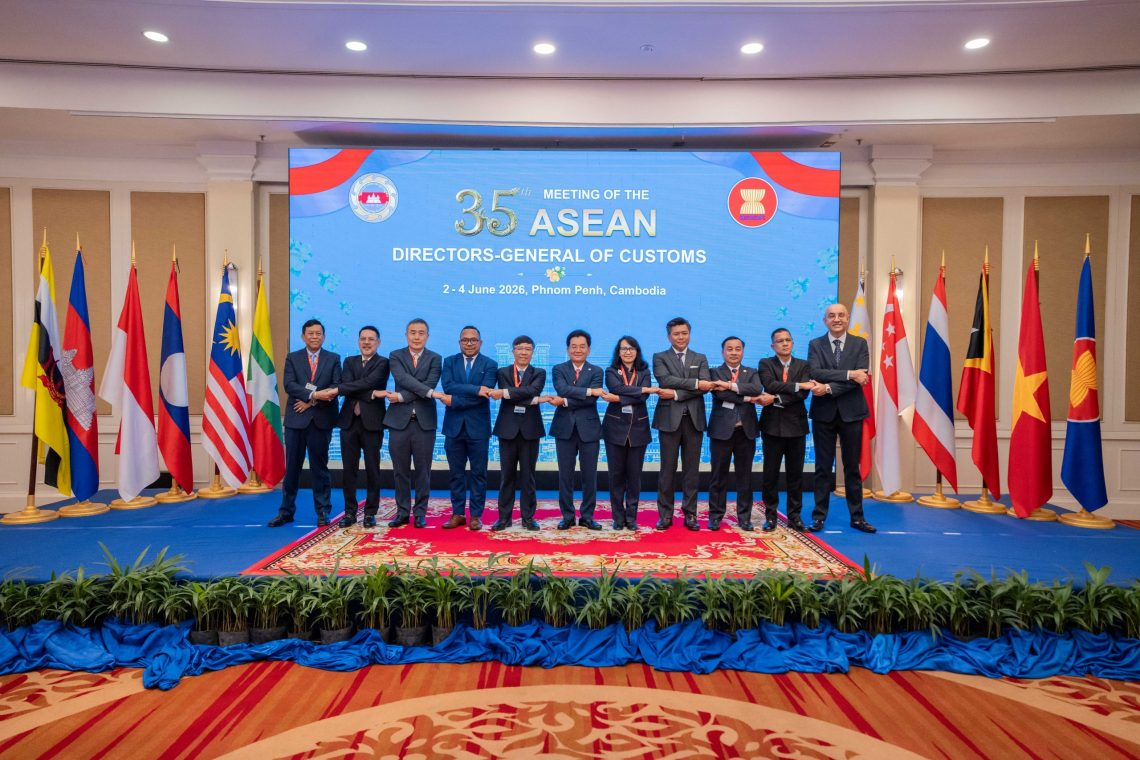
ASEAN customs leaders reaffirmed their commitment to trade facilitation, digital transformation, and supply chain resilience during the 35th Meeting of the ASEAN Directors-General of Customs in Phnom Penh, Cambodia
The 35th Meeting of the ASEAN Directors-General of Customs was held in Phnom Penh, Cambodia, from 2 to 4 June 2026, bringing together customs leaders from all ASEAN Member States and the ASEAN Secretariat. The meeting focused on strengthening regional trade facilitation, enhancing customs cooperation, and advancing digital initiatives to support resilient and efficient supply chains across Southeast Asia.
Chaired by H.E. Dr. Kun Nhem, Minister Attached to the Prime Minister and Director-General of the General Department of Customs and Excise of Cambodia, the meeting served as a platform for ASEAN customs authorities to review progress on regional customs initiatives and discuss emerging challenges affecting international trade. Discussions took place against the backdrop of global economic uncertainties, including disruptions to supply chains and trade flows resulting from tensions in the Middle East.
Participants expressed concern over the impact of geopolitical developments on global trade and logistics. ASEAN customs administrations reaffirmed their commitment to strengthening supply chain resilience, enhancing coordinated customs procedures, and ensuring the uninterrupted movement of essential goods across the region. Officials also emphasised the importance of transparency, predictability, and digitalisation in customs processes to support businesses and maintain trade continuity.
A key focus of the meeting was the advancement of regional customs integration. Delegates noted the implementation of the ASEAN Authorised Economic Operator Mutual Recognition Arrangement (AAMRA) by nine ASEAN Member States and encouraged broader participation to strengthen regional supply chains and facilitate intra-ASEAN trade. The meeting also welcomed progress toward future Authorised Economic Operator Mutual Recognition Arrangements with ASEAN Dialogue Partners, including the planned commencement of discussions with China in July 2026.
The meeting reviewed developments under the ASEAN Customs Transit System (ACTS), including Myanmar’s accession as the seventh participating member state. Officials also discussed plans to pilot railway-based transit operations among Malaysia, Thailand, and Lao PDR by the end of 2026, while encouraging further preparations for the Borneo Corridor pilot involving Brunei Darussalam and Indonesia.
Delegates endorsed the Roadmap for the Next Generation of the ASEAN Single Window (ASW 2.0) for the period 2026–2030. The roadmap will guide the expansion of electronic trade document exchanges within ASEAN and with external partners, enhancing digital connectivity, reducing compliance costs, and improving customs interoperability. ASEAN customs authorities also reaffirmed their commitment to advancing cooperation with China through Single Window connectivity initiatives.
The meeting welcomed the conclusion of negotiations for the ASEAN Digital Economy Framework Agreement (DEFA), which is expected to be signed later in 2026. Participants noted that the agreement would support paperless trade, accelerate the adoption of digital technologies in customs operations, improve security measures, and reduce trade transaction costs.
Further discussions addressed updates to the ASEAN Harmonised Tariff Nomenclature (AHTN) 2028, progress in combating origin fraud through Joint Customs Control operations, and ongoing efforts to strengthen customs leadership and capacity building through regional training programmes. Delegates also reviewed developments in regional and external free trade agreements, including the ASEAN Trade in Goods Agreement, ASEAN-China Free Trade Agreement 3.0, and negotiations with Canada, India, and the Republic of Korea.
Source: The ASEAN Secretariat