Indonesia plans solar facilities near Batam to supply Singapore with power from 2027.
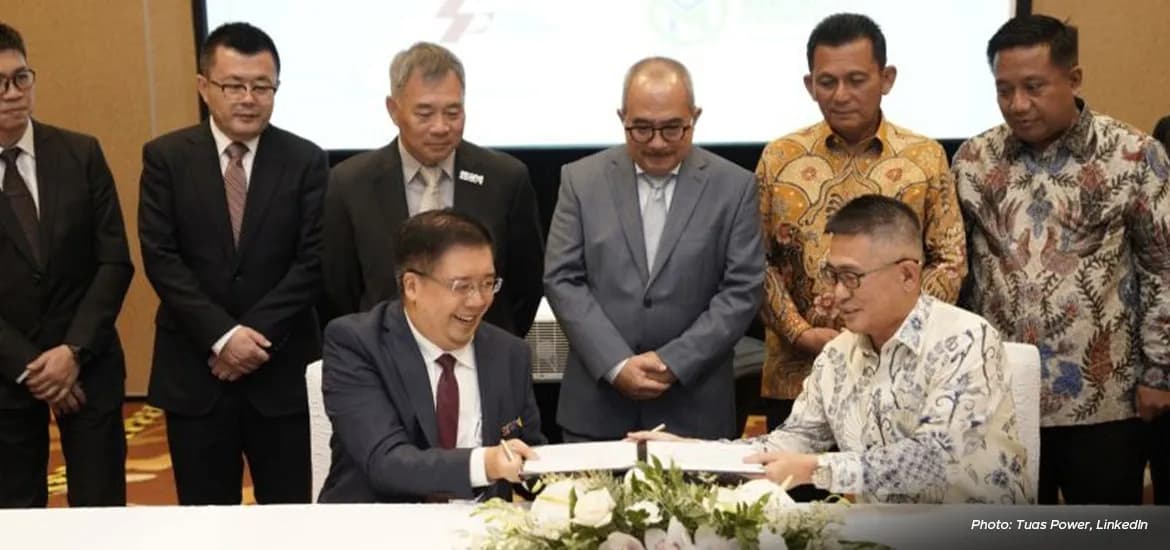
Indonesia-based renewable energy company Marubeni Global Indonesia (MGI) intended to develop a US$9 billion (S$12.3 billion) solar power project near Batam, with electricity deliveries to Singapore targeted for 2027. Under a memorandum of understanding signed on October 23, 2023, MGI agreed to provide up to 600 megawatts (MW) to Singapore power generation company Tuas Power through undersea cables. The output could serve about 730,000 households.
The company intended to start the first stage in March 2024 on Galang Island, south of Batam in Riau Islands province. MGI managing director Mr Tjaw Hioeng said the initial solar farm would have a capacity of 2.55 gigawatt-peak (GWp). The wider scheme was expected to comprise about 4.1 GWp of solar capacity and 10 GWh of battery energy storage.
“Our Singapore partner requires the electricity to be connected to the grid by the end of 2027,” Mr Hioeng said.
Tuas Power chief operating officer Mr Michael Wong said the Singapore utility would initially take up to 400 MW, with volumes rising towards 600 MW as the second stage progressed. MGI intended to extend the initiative to nine less-populated or uninhabited islands near Batam after the first solar farm began operating in 2027.
Mr Wong described the arrangement as a “long-term supply that will span 25 to 30 years”. He said the full 600 MW would represent about 15% of Singapore’s target at the time to import 4 GW of renewable energy by 2035.
Tuas Power was due to submit its proposal to Singapore’s Energy Market Authority (EMA) by the end of November 2023. In September that year, EMA granted conditional approval to five projects to import a combined 2 GW of low-carbon electricity annually from Indonesia.
The Indonesian government designated the MGI initiative as a national strategic project in April 2023. Mr Akhmad Ma’ruf Maulana, chairman of the Riau Islands chapter of the Indonesian Chamber of Commerce and Industry, said the initiative could encourage domestic manufacturing of solar components.
“We hope the solar export projects can bring added value to us, create jobs, and support the development of our solar industry,” Mr Akhmad said.
He added that Indonesian requirements for electricity exporters included sourcing at least 60% of solar farm components domestically. Several companies had also invested in Batam to manufacture solar cells and modules.
Mr Putra Adhiguna, Asia energy technology research lead at the US-based Institute for Energy Economics and Financial Analysis, said electricity exports could increase demand for Indonesia’s low-carbon generation and support further investment in the sector.
Source: Singapore Economic Development Board (EDB)