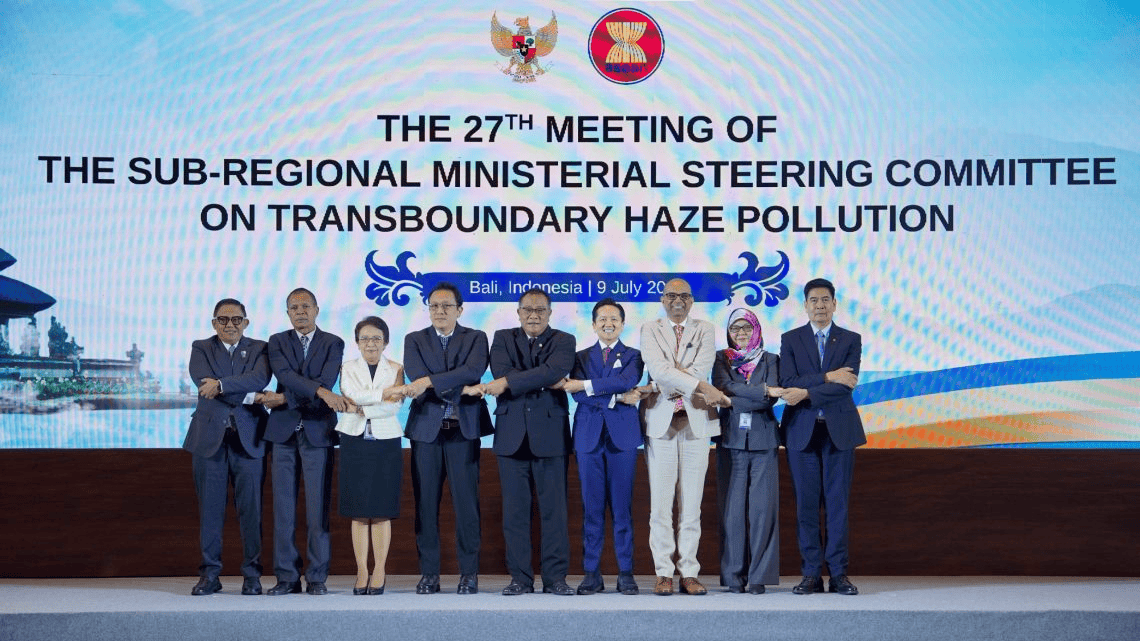
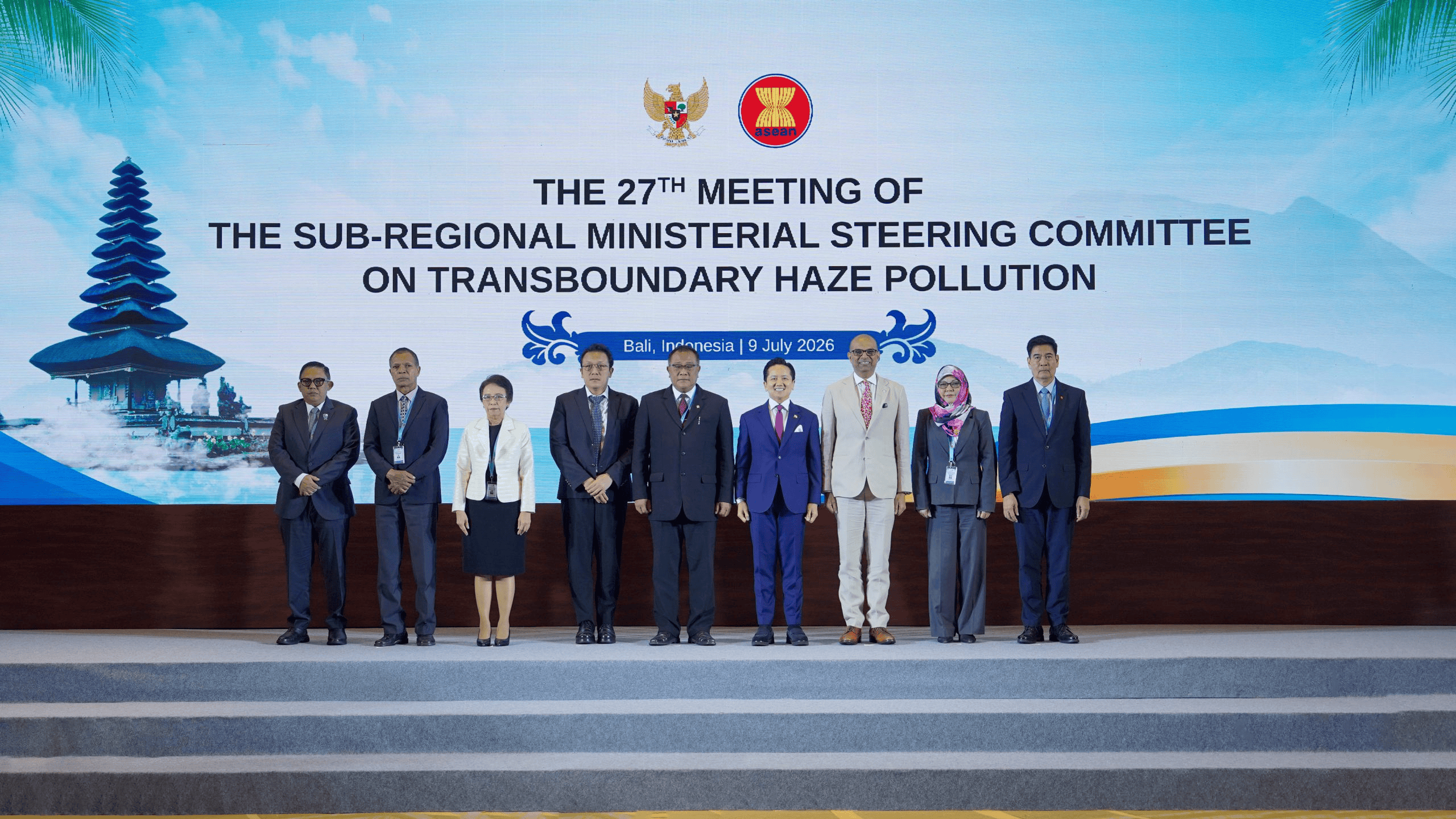
ASEAN ministers and senior officials renewed their commitment to strengthening regional cooperation on transboundary haze pollution during the 27th Meeting of the Sub-Regional Ministerial Steering Committee in Bali. The meeting also highlighted preparations for the ASEAN Coordinating Centre for Transboundary Haze Pollution Control and growing concerns over heightened fire risks linked to El Niño.
Ministers, senior officials and representatives from Brunei Darussalam, Indonesia, Malaysia, Singapore, Thailand and Timor-Leste convened in Bali, Indonesia, on 9 July 2026 for the Twenty-Seventh Meeting of the Sub-Regional Ministerial Steering Committee on Transboundary Haze Pollution (27th MSC). Chaired by Indonesia’s Minister of Environment, H.E. Mohammad Jumhur Hidayat, the meeting reaffirmed ASEAN’s commitment to fully implementing the ASEAN Agreement on Transboundary Haze Pollution (AATHP) and advancing the ASEAN Socio-Cultural Community Strategic Plan under the ASEAN Community Vision 2045. The 27th Meeting of the Technical Working Group on Transboundary Haze Pollution preceded the ministerial session.
A key focus of the meeting was the continued establishment of the ASEAN Coordinating Centre for Transboundary Haze Pollution Control (ACC THPC). Ministers welcomed Indonesia’s progress in preparing the Centre’s legal framework, operational procedures, infrastructure, monitoring capabilities and organisational arrangements. They also acknowledged Viet Nam’s submission of its Instrument of Approval to the Centre’s Establishment Agreement, while encouraging ASEAN Member States to complete their domestic ratification processes to enable the Centre’s full operationalisation.
The meeting also endorsed stronger regional cooperation to address the root causes of haze through sustainable land management. Ministers welcomed the Implementation Plan of the ASEAN Investment Framework for Haze-Free Sustainable Land Management (AIF-HFSLM), which complements the Haze-Free Roadmap and the Second ASEAN Peatland Management Strategy (2023–2030). They encouraged deeper collaboration with existing and new dialogue partners to promote sustainable forest and peatland management, haze-free agricultural practices and responsible commodity production, supporting ASEAN’s goal of achieving a transboundary haze-free region by 2030.
Delegates reviewed the latest weather outlook presented by the ASEAN Specialised Meteorological Centre (ASMC), which reported that hotspot activity across the southern ASEAN region increased by approximately 86 per cent during the first half of 2026 compared with the same period in 2025. With El Niño conditions expected to strengthen in the coming months alongside below-normal rainfall and the possible development of a positive Indian Ocean Dipole, ministers warned that fire risks and transboundary haze could intensify. They reaffirmed their commitment to strengthening prevention, preparedness, suppression and mitigation efforts in line with the Haze-Free Roadmap and the ASEAN Standard Operating Procedure for Monitoring, Assessment and Joint Emergency Response (SOP MAJER).
Looking ahead, the meeting agreed to strengthen bilateral and regional cooperation, including exploring the role of science diplomacy within the AATHP framework and expanding support for scientific research through the ASEAN Transboundary Haze Pollution Control Fund. Ministers also welcomed the recent Memorandum of Understanding between Indonesia and Singapore on environmental cooperation, which includes collaboration on transboundary pollution. The meeting concluded with appreciation to Indonesia for hosting the event and confirmed that the 28th MSC Meeting will be held in Malaysia in 2027, following the 21st Conference of the Parties to the AATHP scheduled for October 2026 in Da Nang, Viet Nam.
Source: The ASEAN Secretariat